
Here's the full text of President Ram Nath Kovind's customary address to the joining sitting of Parliament on the first day of the budget session.

Ajit Balakrishnan offers a thinking man's guide to the angst of the professions.

From India's fight against COVID-19 to China face-off, Kovind spoke on several issues during the televised address.

Asserting that while trade between India and Norway has been expanding but there is significant potential waiting to be realised, he said, "The new government is taking a number of measures to encourage investments, revive the manufacturing sector in India, promote skill development, develop smart cities and engage closely with all interested partners and investors in India and abroad to make this happen".
As someone with nostalgia for the good cheer and friendly feelings of Brazilian people, former Ambassador to Brazil B S Prakash can only hope that when they see on their TV screens their President being feted on Rajpath, they will sense India's goodwill for Brazil.

In a note to his students titled 'In a Background of Elections - The Development Debate', Dr Frazer Mascarenhas, principal of Mumbai's St Xavier's College, slams Narendra Modi's Gujarat and is in all praise of United Progressive Alliance's Rojgar Yojana and the Food Security Act

Yale University has issued a statement saying that Human Resource Development Minister Smriti Irani attended a weeklong programme and received a certificate from the university last year, along with several other lawmakers from India. George Joseph/Rediff.com reports from New York

General Naravane's UAE and Saudi Arabia visits communicate India's long awaited arrival in the domain of integrated foreign policy where the diplomatic and the military domains both complement each other much more substantially, observes Lieutenant General Syed Ata Hasnain (retd).

'We are completely engaged in fighting poverty; alas, our neighbour Pakistan seems only engaged in fighting us.'


Sandeep Pandey salutes women who have contributed to social transformation in India after 1980.

'Happily,' says Ambassador B S Prakash, 'BRICS displayed new-found energy and built something real, a bank. Between needless nihilism and as yet unjustified euphoria, there are many stations for the BRICS train and we can watch its progress with renewed interest.'

Xi Jinping has accumulated great power, but he faces trials that are just as great, says Claude Smadja.

'We don't have to be the world's policeman. We don't have to impose our values. But we need to lead and when we pull back as we've done, you begin to see exactly what happens -- the voids are filled by threats of terror that countries have to suffer with, including India.'

'Indira Gandhi and P N Haksar did not want Pakistan to leave as an embittered foe hell-bent on taking revenge for being humiliated so comprehensively.'
'We have promised to ensure reduced tax rates.'

This is the joint statement issued by the ministry of external affairs on the visit of US President Barack Obama to India.
'A change of government will bring about a lot of changes because everything is frozen for the last two years. So, the frozen energies of India will be released.' Swadeshi Jagran Manch convenor Swaminathan Gurumurthy discusses the Modi phenomenon with Shobha Warrier/Rediff.com

The Politburo Standing Committee -- the most powerful body in China -- is unveiled, but in a break from Communist party convention, no successor to Xi Jinping is named.

'The use of nuclear/biological/chemical weapons by Islamic terrorists is just a matter of time.' 'It must be clearly understood what the world faces is a global level insurgency against the world order.' 'Terrorism is merely a tactic and Islamic State its most brutal face, says Colonel Anil A Athale (retd).

A large chunk of the Rs 8.8 lakh crore of investments the Patnaik government had attracted is in uncertain territory.
'I say Modi was India's last chance.' 'Because the kind of work this government has done -- I'm talking about physical delivery -- is fantastic, like no time in our history.'

The following is the full text of US President Donald Trump's first address to a joint session of the Congress on February 28, as prepared for delivery and released by the White House press office.

If indeed we want the board to manage the RBI, probably the government should take a close look at the US Federal Reserve system which has a two-part structure - a central authority in Washington, DC, and a decentralised network of 12 Federal Reserve Banks located throughout the country, says Tamal Bandyopadhyay.

'Since Modi is walking a tightrope between two worlds -- one of the saffron brotherhood and the other of the proposed smart cities and bullet trains -- it is understandable why he is averse to scrutiny lest he loses his balance by tilting too heavily on one side or the other. But, why has Sonia Gandhi acquired the reputation of a sphinx,' asks Amulya Ganguli.

Donald Trump's executive order prohibiting the entry of people from seven Muslim-majority nations widened the rift between the Trump administration and several leading American companies.

Few readers will remember the socialist utopia of Indira Gandhi when food queues were the norm even for the middle class and tankers supplied water at odd hours of the night twice a week. Is that what you are trying to return us to, dear Congress, asks Jaideep Prabhu

Unless the judges factor in the ungovernability of technologies and their beneficial owners, present and future Presidents, prime ministers, judges, legislators and officials handling sensitive assignments may become redundant with reference to their age-old roles for securing 'national resources and assets', warns Dr Gopal Krishna.

So let's stop focusing the Modi agenda on India Inc and the capital markets, and let's start focusing on the Modi development agenda for the average Indian.
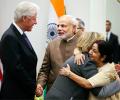
Has the Modi government ensured that the MEA keeps abreast of the times, asks Ambassador Vivek Katju.

'J&K continues to have the highest concentration of military personnel anywhere in the world and the alienation of the Kashmiri has increased in the last ten years than ever before.'

President Pranab Mukherjee on Monday addressed the first joint sitting of Parliament as mandatorily required under the Constitution after the general elections. The address is the political, economic and foreign policy road map of the Narendra Modi government and covers virtually all crucial areas.
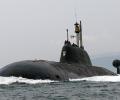
'We have been found seriously wanting in addressing our undersea warfare capability and China's emergence is a cause for concern.'

Just to be clear, "love jihad" -- a concept that claims that Muslim men court Hindu women to convert them to Islam purely to take over India -- doesn't exist, says Mitali Saran
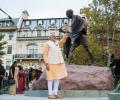
Economists expect Modi to announce big-bang reforms.

The Middle East's power house is about to get a new ruler who is only 31 and he may lead Saudi Arabia for decades, says Ambassador M K Bhadrakumar.
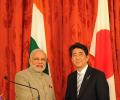
'Secretiveness and the element of surprise in announcing decisions marks the Modi style of diplomacy. From being a voluble politician, he became a reticent statesman... But the diplomatic dance is performed on thin ice and his adroitness is still to be proved,' says Ambassador T P Sreenivasan.

Narendra Modi's victory does not represent a victory of 'the Indian nation', but only an elite-driven polarising phenomenon. The sooner we -- and the BJP -- recognise this, the better, says Praful Bidwai.

Empowered in the Modi government, junior ministers have enough on their plate.

The Diaspora is no longer a mere remittance economy. It today claims dual loyalty and demands a say in Indian politics, says sociologist Shiv Visvanathan
